Understanding the Lunar Phase Cycle: A Practical Guide for Backyard Observers
Why the Moon changes shape every night, how to predict each phase, and which nights actually make the best observing sessions for craters, planets, and deep sky.
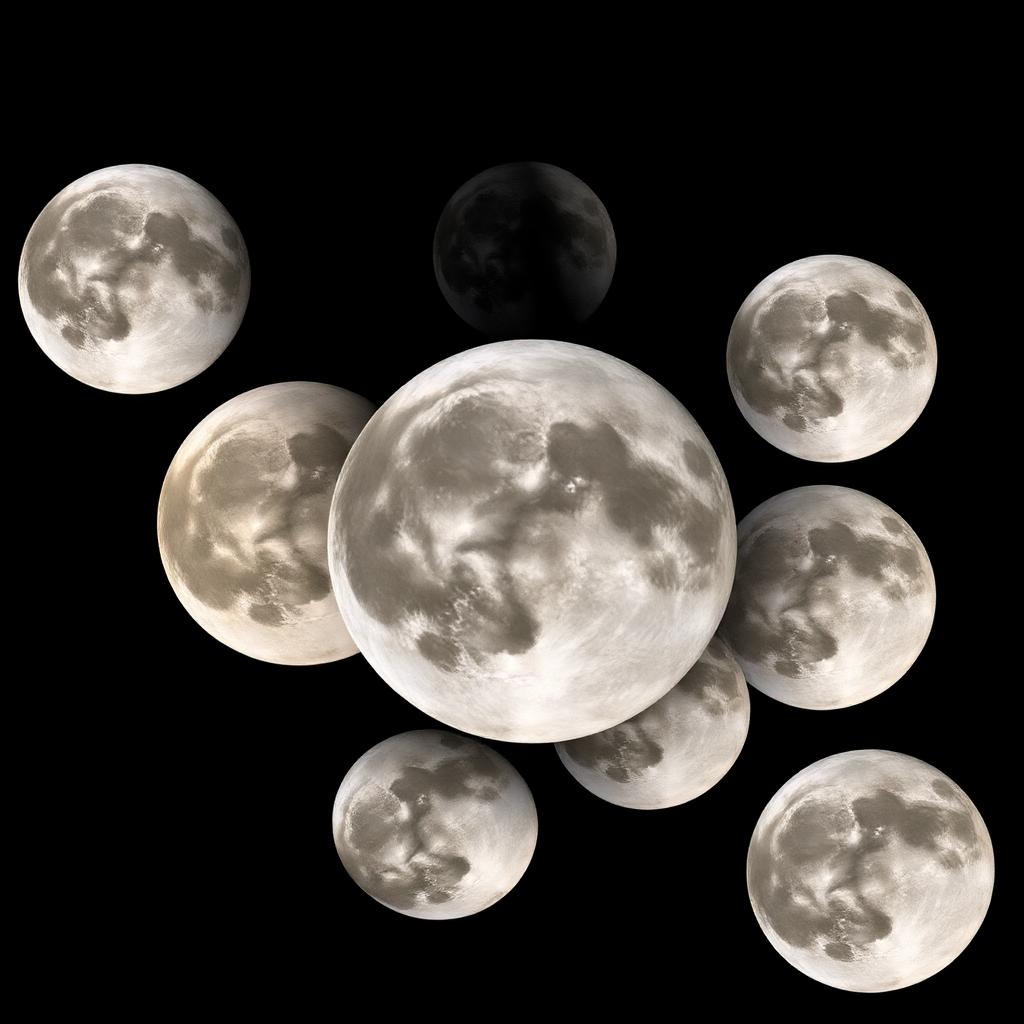
The Moon is the single most rewarding target in amateur astronomy. It is bright enough to observe from a light-polluted city balcony, detailed enough to reveal something new in every eyepiece, and predictable enough that any beginner can plan a session weeks in advance. The reason the Moon looks different every night is not that its shape changes, but that our viewing geometry does. The Sun always lights one half of the lunar sphere; what we call a phase is simply how much of that lit half is turned toward Earth on a given evening.
The full cycle from one New Moon to the next is called a synodic month and lasts, on average, 29.53 days. This is slightly longer than the sidereal month of 27.32 days, which measures the Moon's orbit relative to the distant stars. The extra 2.2 days exist because the Earth itself is moving around the Sun, so the Moon has to travel a bit further to catch back up to the same Sun–Earth–Moon geometry. Understanding this distinction is what separates casual sky watchers from observers who can genuinely predict where the Moon will be at a given hour.
The eight canonical phases
Astronomers divide the synodic month into eight named phases: New Moon, Waxing Crescent, First Quarter, Waxing Gibbous, Full Moon, Waning Gibbous, Last Quarter, and Waning Crescent. The four principal phases (new, first quarter, full, last quarter) are single instants defined by exact elongations of 0°, 90°, 180°, and 270° between the Sun and the Moon as seen from Earth. The four intermediate phases are broad ranges filling the roughly seven-day gap between them.
The word waxing simply means the illuminated fraction is growing, and waning means it is shrinking. During the waxing half of the month the Moon is visible in the evening sky and sets after the Sun. During the waning half it rises after midnight and dominates the pre-dawn hours. A common beginner mistake is expecting to see the Moon at any time of night regardless of phase; in reality the phase is a rigid clock that tells you exactly when the Moon will be above your horizon.
Where the terminator lives
For telescopic work the most important feature of any phase is not the illuminated fraction but the position of the terminator, the sharp line dividing lunar day from lunar night. Along the terminator, the Sun sits low on the local horizon and every crater rim, wrinkle ridge, and mountain casts a long, dramatic shadow. Details that look flat and washed out on the fully illuminated portion pop into three-dimensional relief here.
This is why experienced lunar observers prefer the days around first and last quarter rather than the visually spectacular full Moon. At full phase, the Sun is directly behind you (from the Moon's point of view) and shadows collapse to almost nothing; the disk looks like a bright dinner plate rather than a landscape. Between quarter and gibbous, however, a new strip of terrain reveals itself every 24 hours as the terminator sweeps across the surface.
Planning a lunar session
A useful rule of thumb: whatever crater or feature you want to study, wait until the terminator is within about two lunar days of it. The Moon rotates on its axis in the same period it orbits Earth, so features rise into sunlight at roughly a predictable pace of 12° of lunar longitude per Earth day. Free tools such as our Moon Phase Explorer and Terminator Position Calculator will hand you the exact colongitude for any date without spreadsheet math.
If deep sky is your target instead, the Moon is your enemy. Even a fat crescent floods the sky with enough scattered light to wash out faint galaxies. Serious deep-sky observers plan their outings for the ten-day window centered on New Moon and treat the rest of the month as a lunar and planetary period. Learning to switch mentally between these modes is one of the fastest ways to make more observations per year.
Common misconceptions
Phases are not caused by Earth's shadow. Earth casts a shadow on the Moon only during a lunar eclipse, which happens at most a few times per year. Ordinary phases are pure geometry between the Sun, Moon, and observer. Similarly, the Moon does not rotate; it does rotate, once per orbit, which is precisely why the same face is always turned toward us. Both errors are surprisingly persistent even among people who paid attention in school.
The Moon's apparent size also changes very slightly over the month because its orbit is elliptical, giving rise to the so-called supermoon and micromoon effects. The difference is real but small, about 14% in diameter between the extremes, and almost impossible to notice by eye without a side-by-side reference photo. Do not let clickbait headlines convince you a supermoon is a dramatic visual event; the far better story is that any full Moon is a magnificent target of a five-billion-year-old world you can see with your own eyes.