Your First Telescope: What Actually Matters and What Does Not
Aperture, mount, focal length and eyepieces demystified, plus honest advice on why the best first telescope is rarely the one with the biggest number on the box.
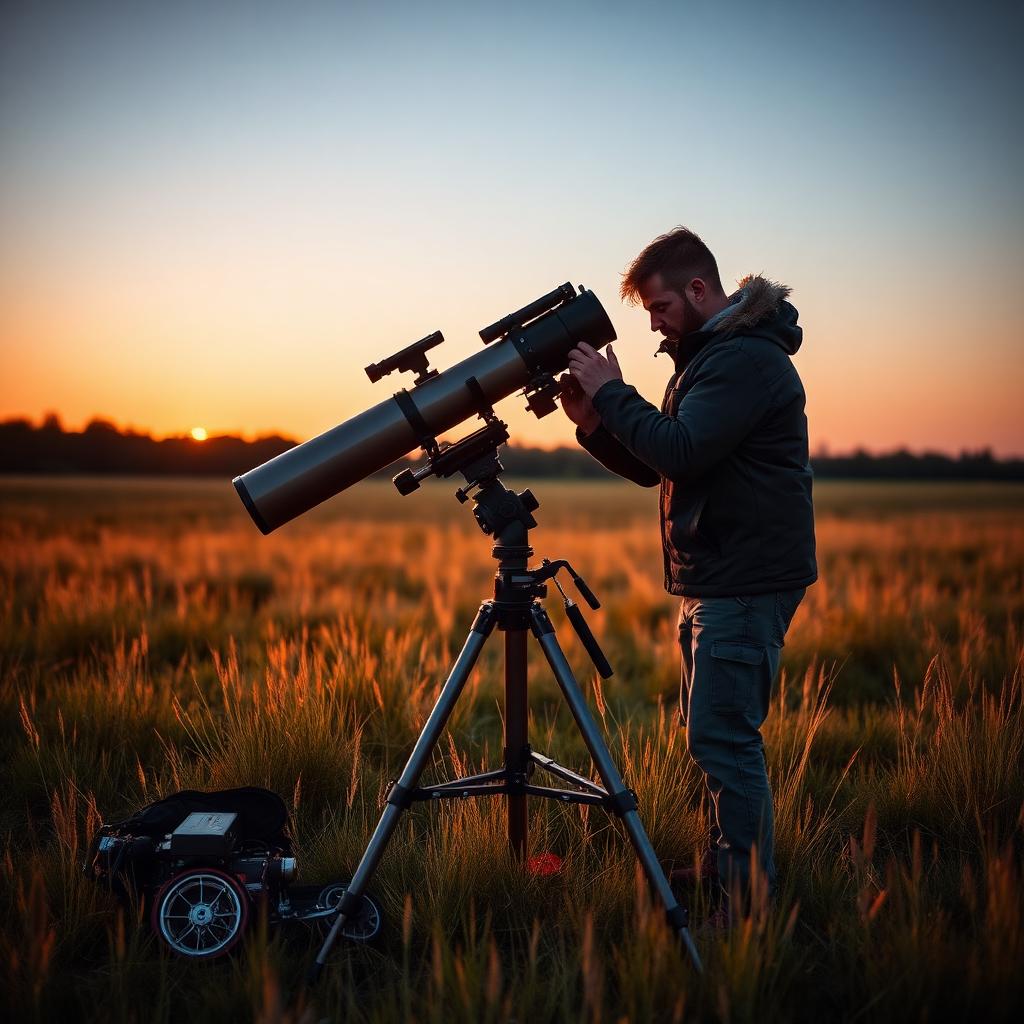
Every year, thousands of would-be astronomers receive a telescope as a gift, use it twice, and then quietly retire it to a closet. The instrument is rarely the problem; the mismatch between the instrument and its owner almost always is. A first telescope is a partnership. It has to match your realistic patience, your storage space, your local sky, and the sort of objects that will keep you excited for more than a single night.
The good news is that the underlying decision is much simpler than the marketing suggests. There are really only three variables that matter: aperture, mount stability, and portability. If you understand how those three interact, you can walk past 90% of the confusing options and land on something you will actually use.
Aperture is king, but only if you can lift it
The diameter of a telescope's main lens or mirror, called its aperture, controls two things: how much light it collects and how much detail it can resolve. Doubling the aperture quadruples the light-gathering area, which is why a 200mm reflector will show a galaxy that is completely invisible in a 100mm one. Serious visual observers therefore chase aperture the way photographers chase sensor size.
The unspoken cost is that aperture scales with weight and awkwardness. A 200mm Dobsonian reflector might weigh 25 kilograms fully assembled and take up more floor space than a coffee table. If you have to carry it down three flights of stairs into a car every clear night, you will simply stop using it. A slightly smaller instrument you can grab in ninety seconds will produce ten times as much observing time per year, and observing time is what actually delivers experience.
The mount matters as much as the tube
A tube on a wobbly tripod is a tube you cannot use. Every gust of wind, every touch of the focuser, and every step nearby will send the image dancing. At high magnification, waiting five seconds for vibrations to settle after each nudge turns observing into a stress test rather than a pleasure. Never buy a telescope where the mount looks like an afterthought.
For a first scope, two mounts stand out. The classic Dobsonian is a simple azimuth-altitude cradle that sits on the ground and moves with a push of the hand; it delivers rock-solid pointing per dollar and requires zero setup. Equatorial mounts follow the sky's rotation with a single motorised axis and are essential for astrophotography, but they demand polar alignment and a serious learning curve, so they are best kept for a second instrument.
Focal length, ratio, and eyepieces
Focal length is the distance from the objective to where light comes to focus, and it, combined with your eyepiece, sets magnification. Divide focal length by eyepiece focal length to get power: an 1200mm scope with a 25mm eyepiece yields 48x, ideal for browsing star fields; the same scope with a 6mm eyepiece yields 200x, ideal for the Moon and planets. Most beginners are told to obsess over magnification, when a wide, low-power view is often more thrilling.
Two eyepieces cover most of what a beginner needs: a comfortable low-power one around 25mm for finding objects and a medium-power one near 10mm for detail. A Barlow lens doubles either without adding much cost. Ignore any manufacturer claim of 500x on a small refractor; the atmosphere itself limits useful magnification to roughly twice the aperture in millimetres, and pushing beyond it produces a big, dim, blurry blob.
Realistic recommendations
For an adult beginner who wants the maximum learning per dollar, a 6-inch (150mm) or 8-inch (200mm) Dobsonian is the classic answer, and it has been the classic answer for four decades because nothing beats it. Setup takes 30 seconds, the view of Jupiter's belts and the Orion Nebula is immediately memorable, and the same instrument will still be worth using in ten years' time. Prices for a solid new unit sit near the cost of a mid-range smartphone.
For families with children, or observers who need something that lives in a bookshelf, a small 70 to 80mm refractor on a sturdy alt-azimuth mount is a better fit. It will not chase faint galaxies, but it will show the Moon in gorgeous relief, split double stars, reveal Saturn's rings, and travel easily to campsites. The best telescope in the world is always the one that ends up outside on a clear night rather than in a box in the garage.