Planning a Successful Meteor Shower Night: From Radiant to Reality
How to read predicted rates, why the radiant matters more than the peak hour, and the small preparation choices that separate a memorable meteor watch from a disappointing one.
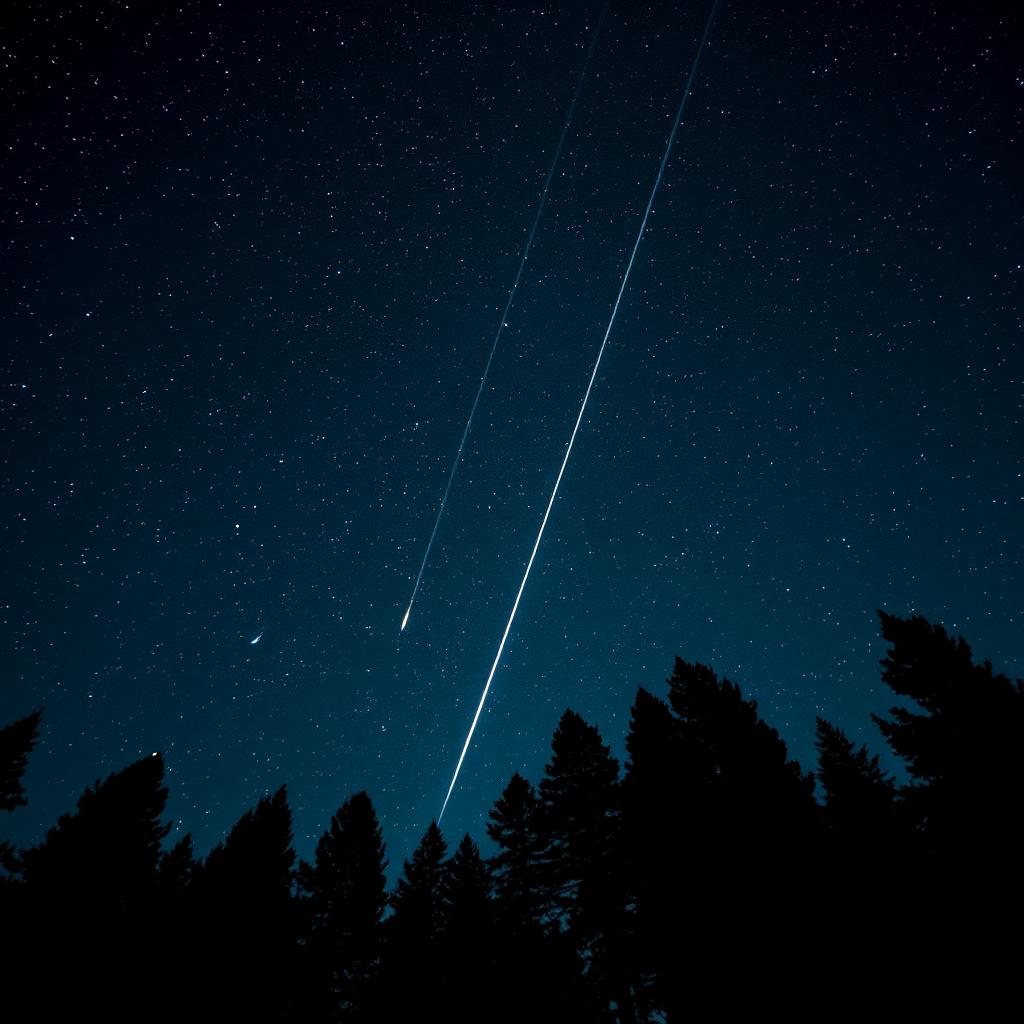
Meteor showers are the most democratic event in astronomy. There is no equipment to buy, no calibration to worry about, no complicated star chart to memorise. You lie on your back, you look up, and eventually something magnificent happens. Yet many people come away from advertised showers disappointed, having stood outside for twenty minutes and seen nothing. The gap between an underwhelming meteor night and an unforgettable one almost always comes down to preparation, not luck.
A meteor shower is caused by Earth ploughing through a debris trail left behind by a comet, or occasionally an asteroid. Grain-sized particles hit the upper atmosphere at tens of kilometres per second, ionising the air along their path and creating the brief streak of light we call a meteor. Because these particles all travel on roughly parallel paths through space, they appear to radiate outward from a single point on the sky, called the radiant, thanks to perspective, the same way parallel railway tracks appear to converge in the distance.
Read the ZHR honestly
Every shower is advertised with a Zenithal Hourly Rate, or ZHR: the number of meteors an ideal observer would count in one hour under a perfectly dark sky with the radiant directly overhead. Almost nobody ever experiences the ZHR. Your true rate is knocked down by the altitude of the radiant, by clouds, by the Moon, by suburban light pollution, and by every second you spend looking at your phone.
A shower with a ZHR of 100 becomes perhaps 30 to 40 per hour under a typical suburban sky and a radiant halfway up. The same shower under a Bortle 8 city glow with the radiant near the horizon might yield five meteors per hour, all bright ones. Set your expectations against your real conditions, not the press release headline, and you will enjoy the night more.
Choose your window carefully
Peak nights matter, but the specific hour matters even more. Most showers produce their best displays between local midnight and the first hint of dawn. This is when your side of Earth is facing directly into its orbital motion, so meteors sweep in like raindrops on the windshield of a moving car rather than catching up from behind. You will see roughly two to three times as many meteors in the pre-dawn hours as you will in the evening, for the same shower and the same sky.
The Moon is the second big variable. A shower peaking three days before Full Moon is essentially cancelled for most observers; the sky background is too bright to see all but the brightest fireballs. Cross-check the shower peak against the Moon phase for that date; if they clash, plan to observe a night or two on either side of the peak when the geometry is friendlier.
Site, comfort, and dark adaptation
The single biggest gain most urban observers can make is driving twenty minutes further from city lights. Meteor visibility is not linear with sky darkness; it is roughly exponential. Every magnitude of sky improvement roughly doubles your visible meteor count because most meteors are faint and hide in the sky glow. Use a light-pollution map to find the nearest genuinely dark patch, even if it is a rural park or a quiet farm road.
Bring a reclining chair, a sleeping bag, and hot drinks. Meteor watching is a game of stillness and patience, and cold shoulders end sessions early. Give your eyes at least twenty minutes to adapt to the dark. A single glance at a bright phone screen resets that adaptation to zero. If you must use your phone, install a red-only night mode and dim the screen to its minimum.
What to expect at the eyepiece
Do not point a telescope or binoculars at the sky. Meteors are wide-field events that can appear anywhere in the hemisphere above you. Both instruments cut your field of view to a small keyhole and will make you miss almost every meteor. The correct instrument is your unaided eye pointed roughly 40 to 60 degrees away from the radiant, where meteors are long and dramatic rather than short and foreshortened.
Keep a simple tally on paper if you want to contribute observations. Note the time, the direction, and the estimated brightness of anything you see. Amateur reports fed to the International Meteor Organization genuinely improve our understanding of debris streams. Even if you never report a single count, the discipline of watching and recording makes each meteor land in memory more sharply than a passive glance would.