Observing the Bright Planets Through a Small Telescope
What Jupiter, Saturn, Mars and Venus actually look like at the eyepiece, when to observe each, and the small technique changes that transform a fuzzy dot into a memorable view.
Planets have quietly stolen more people into a life of amateur astronomy than any other class of target. Deep sky objects reward practice and dark skies, but planets are visible from balconies, apartment windows, and city parks alike. You do not need to escape light pollution; the Moon, Jupiter, Saturn, and Venus are indifferent to sodium street lamps because they are essentially point sources of enormous brightness compared with anything else.
A small telescope, even one under 100mm of aperture, is capable of astonishing planetary views once you learn to work with the atmosphere, the eyepiece, and your own eyes. The single biggest reason beginners come away from a planet feeling underwhelmed is that they expected the vivid, saturated close-ups from spacecraft. The reality at the eyepiece is subtler and, once your eye is trained, arguably more moving because you are seeing the real photons that left the planet minutes earlier.
Jupiter: the beginner's masterpiece
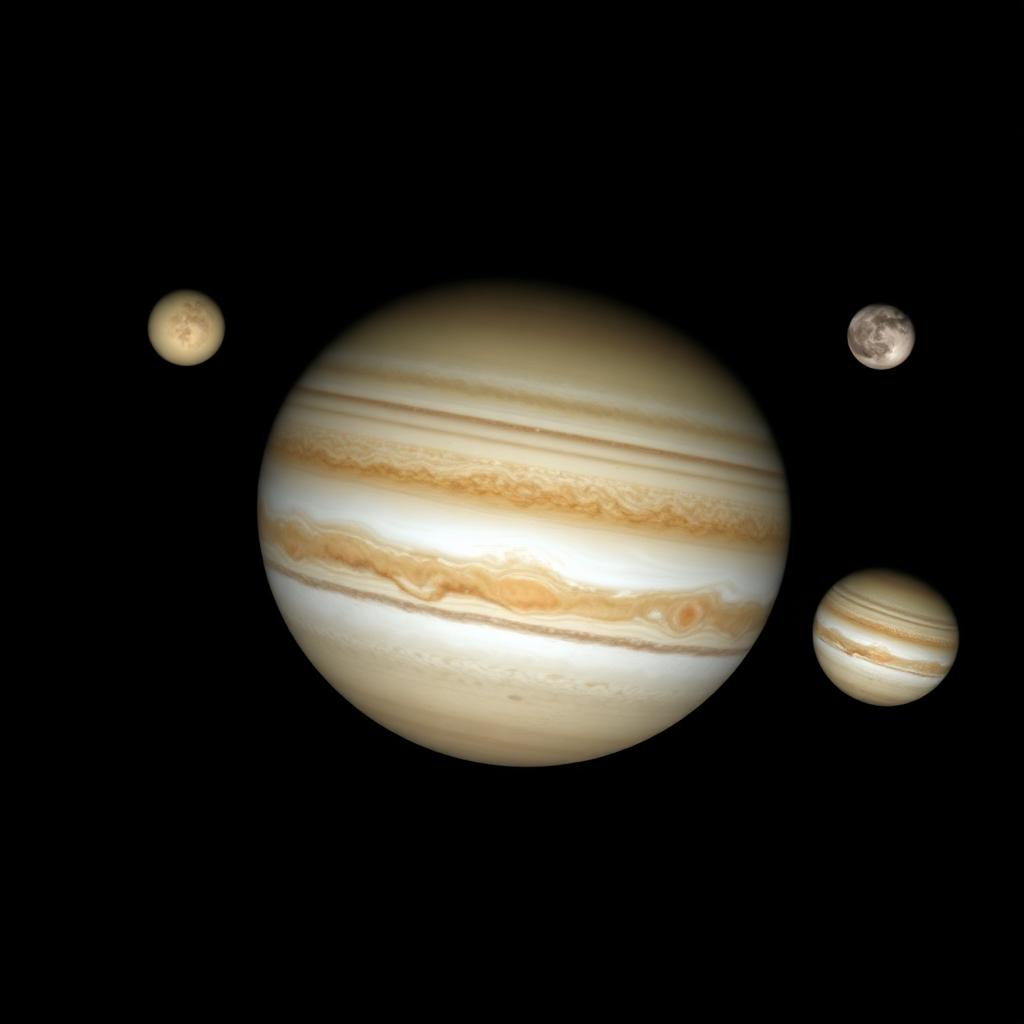
Jupiter is the planet that turns visitors into observers. Even at 60x magnification in a small refractor you will see a bright, flattened disk with two brownish equatorial cloud belts running horizontally across it. Push to 120x on a steady night and additional temperate belts, festoons, and the famously variable Great Red Spot become visible. Jupiter's atmosphere is dynamic on human timescales, so no two apparitions look quite the same.
The four Galilean moons, discovered by Galileo in 1610, are visible in any pair of binoculars and dance around the planet in a few days. Their configuration changes hour by hour, and it is genuinely thrilling to watch a moon pass in front of Jupiter's disk, casting a jet-black shadow onto the cloud tops. Free ephemeris tools will predict every transit, shadow crossing, and mutual event weeks in advance so you can catch them intentionally rather than by luck.
Saturn: the moment that hooks you
Saturn through a telescope is the classic conversion moment. First-time observers audibly gasp when the tiny yellow disk and its impossible-looking ring system snap into focus. A 90mm refractor at 100x shows the rings cleanly separated from the planet's body, the shadow of the planet on the far side of the rings, and the largest gap in the ring system, the Cassini Division, on nights of good seeing.
The ring tilt changes over Saturn's 29.5-year orbit, so views vary from a knife-edge line (when we see the rings edge-on) to a spectacular 27-degree opening. Titan, Saturn's biggest moon, is easy in any small scope, and up to four more moons can be spotted from suburban skies. Give yourself several minutes at the eyepiece; a first glance shows the outline, but the details emerge as your eye adjusts.
Mars: patience is required
Mars is the most technically demanding of the bright planets. It is much smaller than the gas giants and only close enough to show detail near opposition, roughly every 26 months. Between those windows the disk shrinks to a tiny gibbous phase where even large scopes struggle to show more than a coloured smudge. Do not judge Mars by an off-year attempt.
During a good opposition, however, a small telescope will show the polar caps, the darker albedo features such as Syrtis Major, and the seasonal shifts in dust across the surface. Coloured filters (orange or red) improve contrast significantly on Mars and are one of the few filter categories that genuinely help visual observers rather than just marketing to them.
Venus, Mercury, and the outer worlds
Venus is bright enough to hurt at night and shows classic crescent-to-gibbous phases like a miniature Moon. You will not see surface detail; Venus is permanently cloud-shrouded. Mercury behaves similarly on a smaller scale and requires observing at twilight when it is safely below solar glare. Both worlds reward those who track apparitions with a solar-system tracker.
Uranus and Neptune are within reach of a modest scope but appear as tiny bluish disks rather than dramatic targets. Locating them and confirming the identification is a small triumph in itself, and you will have joined the historically small club of humans who have personally seen the ice giants with their own eyes. Combine planetary observing with lunar and double-star sessions for the highest ratio of good views per clear night.